
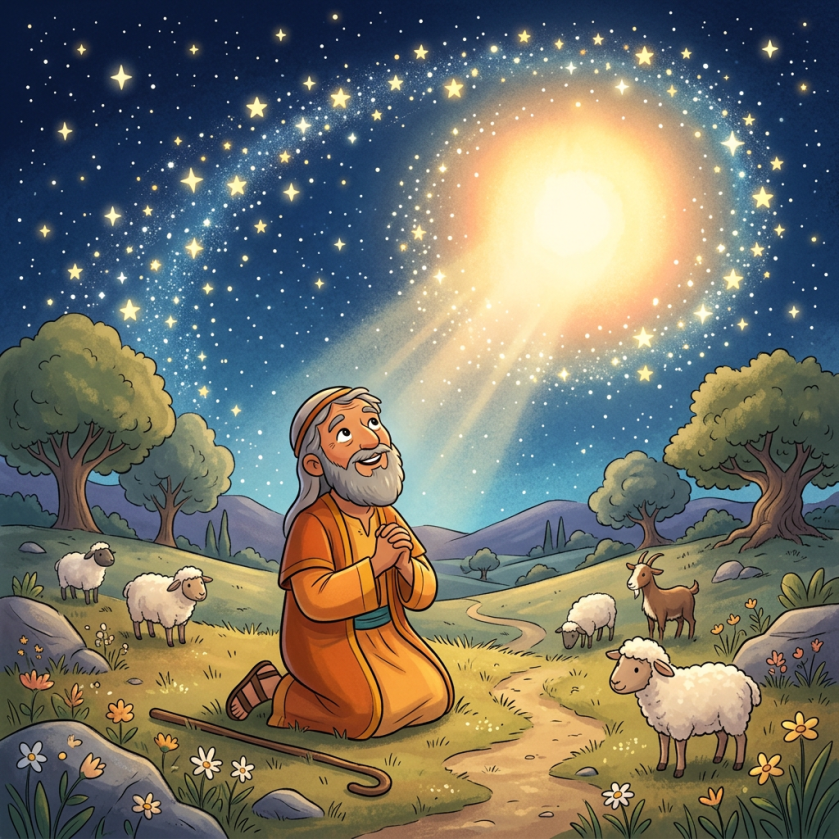
Genesis 15:7-21. 7And [God] said to [Abraham], “I am the Lord who brought you out from Ur of the Chaldeans to give you this land to possess.” 8But he said, “O Lord God, how am I to know that I shall possess it?” 9He said to him, “Bring me a heifer three years old, a female goat three years old, a ram three years old, a turtledove, and a young pigeon.” 10And he brought him all these, cut them in half, and laid each half over against the other. But he did not cut the birds in half. 11And when birds of prey came down on the carcasses, Abram drove them away. 12As the sun was going down, a deep sleep fell on Abram. And behold, dreadful and great darkness fell upon him…17When the sun had gone down and it was dark, behold, a smoking fire pot and a flaming torch passed between these pieces. 18On that day the Lord made a covenant with Abram, saying, “To your offspring I give this land, from the river of Egypt to the great river, the river Euphrates, 19the land of the Kenites, the Kenizzites, the Kadmonites, 20the Hittites, the Perizzites, the Rephaim, 21the Amorites, the Canaanites, the Girgashites and the Jebusites.”
When I was a kid we would say this little poem whenever we would make a promise: “cross my heart hope to die, stick a needle in my eye?” Looking back on it, I can see how this was sort of extreme. Saying “I hope to die,” may have been a bit much. But it did show how serious you were about keeping your promise.
In the Bible, when God makes promises to his people they often became what is called a covenant. A covenant was a set of promises that two people would make to each other. Like an agreement, or making a deal. I promise to do “this,” and you promise to do “that.”
In Abraham’s day, when two people made a covenant, they didn’t say, “Cross my heart, hope to die.” They did something far more extreme. You can read it in the story from Genesis 15 above. What did they do? Look at verse 10 above. They took a bunch of animals, cut them in half and then walked between them. Gross!
Why did they do this? To demonstrate that if either person breaks their promises to the other…well, let’s just say it won’t be a nice ending. Someone will end up looking like those dead animals.
Remember, God has already made promises to Abraham. The promise of land, and of children, and of being blessed. But, as we’ve seen, Abraham is doubting. He has questions. So God decides to go through the covenant ceremony that people back then would use. Cut up some animals, and walk through the pieces while making our promises. But look at verses 12 and 17 again. Did Abraham walk through the animal pieces? That’s right, he didn’t. Instead, while Abraham slept, smoke and fire went through the pieces. What do you think the smoke and fire represented? That’s right! God.
Only God went through the pieces. Only God made promises. Why is that so important? Because that is exactly how God relates to us today. Just like God didn’t ask Abraham to make any promises to God, with Jesus, we don’t have to make any promises to God either. Jesus has done it all. Jesus has made and kept all of God’s promises. And, on top of that, Jesus has died in our place for all the promises to God that we have failed to keep.
Never forget, God doesn’t want your promises. He wants you to trust his promises. Christians call it the New Covenant. A new set of promises that Jesus makes to us including the promise to forgive all of our sins and give us the Holy Spirit to change our hearts and make us more like Jesus.
You: Do you ever make promises to God/Jesus? What do you do when you break your promises?
You with Jesus: How does Jesus and his cross show us that God does not need us to make promises to him? In what way does Jesus keep all of God’s promises to us (especially the promises to forgive us and change us)?
Prayer: Father, your New Covenant promises are so amazing. I can’t believe you have promised to forgive me and make me like Jesus. Help me remember that I don’t have to make promises to you, but instead I can trust all your promises to me. Amen.

